Why Your Low Register Sounds Bad (It's Not What You Think)
Why Your Low Register Sounds Bad (It's Not What You Think)
Here's what most oboists do when their low register sounds bad.
They practice it more.
More long tones. More slow scales. More conscientious air support. More embouchure focus.
And the low register still sounds bad.
Because the problem isn't your playing. The problem is your reed.
What "Bad Low Register" Actually Sounds Like.
Let me be specific, because "bad low register" means different things on different days.
Shallow and thin. Low G sounds the same as Low A. There's no depth, no spread to the tone. Notes below the staff feel like they're on the surface of the sound, not inside it.
Flat under pressure. You try to play with real air support and the low notes sag. Pianissimo is manageable. Anything louder collapses.
Resistant and stuffy. Notes don't speak freely. You're fighting for every attack. The reed feels locked up when you need it to open.
These are three different problems with four different fixes. But they all live in the same part of the reed.
The Back of the Reed Controls the Low Register
The tip controls response and attack. The middle controls resistance and tone color. The back — channels, spine, heart — controls pitch stability and low note depth.
This is why scraping the tip to fix your low register is almost always wrong. You're working in the wrong zip code.
The specific area for low note depth is the channels of the back... the two channels that run alongside the spine on each blade. When those channels are opened appropriately, low G deepens. The note spreads. You get what the oboe is actually capable of.
Well, let me digress first.. Make sure your oboe is sealing!!!!!
Back to the reed...
Here's how I test it:
Slur from Low A down to Low G. Don't change your embouchure. Don't push air. Just slur.
Low G should be noticeably deeper than Low A — rounder, darker, more resonant — without you doing anything extra.
If Low G sounds basically the same as Low A? The channels aren't open enough, or the opening of the reed is too tight.
The Flat-Under-Pressure Problem
This one is a pitch stability issue, and it lives in a different spot.
When the reed goes flat under strong air support, the octave E, F#, and G test will expose it. Play those notes forte. Stop-tongued, short attacks. Does the pitch hold? Or does it drop?
If it drops, the back of the reed isn't providing enough resistance to hold up under pressure. The channels of back need work — but specifically the upper third, which controls pitch on those middle-high notes.
A few light strokes in the upper third of each channel. Test. Repeat.
Again — almost no pressure with the knife.
The Stuffy Low Register
Stuffiness in the low register usually means the reed is too closed. Not enough opening.
The fix here is opening the reed up, not scraping it. Check the tip opening. There need to be enough.
Scraping the transition from the tip to heart more towards the left and right of the tip spine can free up the vibrations. The just scrape the channels. very lightly and test.
Sometimes the low register sounds bad because the reed is tied incorrectly.
Too much blade overlap at the staple changes the vibrating geometry of the entire reed. The low register never sounds right because the structure is wrong from the start.
This is especially common with student reeds — commercial reeds, machine-made reeds, reeds made from the wrong gouge thickness for your staple size. You can adjust all day. The foundation is off.
If the reed is over-tied or under-tied, forget it.
At some point, the answer isn't adjusting this reed. The answer is making better reeds.
The Bottom Line
Your low register isn't a playing problem. It's a reed problem.
Test it. Slur Low A to Low G. Does G deepen? If not, you know where to start.
Work the channels. Almost no pressure. Test after every stroke. Check and see if you can articulate repeatedly the low d and d fat. If you can't, start in the transition and work back.
Frequently Asked Questions
Q: Why do my oboe low notes sound thin and shallow? Thin, shallow low notes mean the back channels aren't open enough or the reed opening is too tight. Low G should sound noticeably deeper than Low A without any embouchure change. If it doesn't, start with the corners of the tip and the channels of the back.
Q: Why do my oboe low notes go flat when I play loud? Flat low notes under pressure is a pitch stability problem. The back of the reed isn't providing enough resistance to hold up under strong air support. Light work in the upper third of the back channels addresses this — a few strokes, test, repeat.
Q: Why is my oboe low register stuffy and resistant? Stuffiness usually means the reed is too closed. Check the tip opening — there should be enough opening. No amount of scraping fixes a reed that's clamped shut. The opening needs to be addressed first.
Q: Why won't my oboe low C speak reliably? Poor low note response is often a combination of too little opening and insufficient back channel depth. It can also indicate the reed was tied incorrectly. If adjustment doesn't resolve it, the problem may be structural.
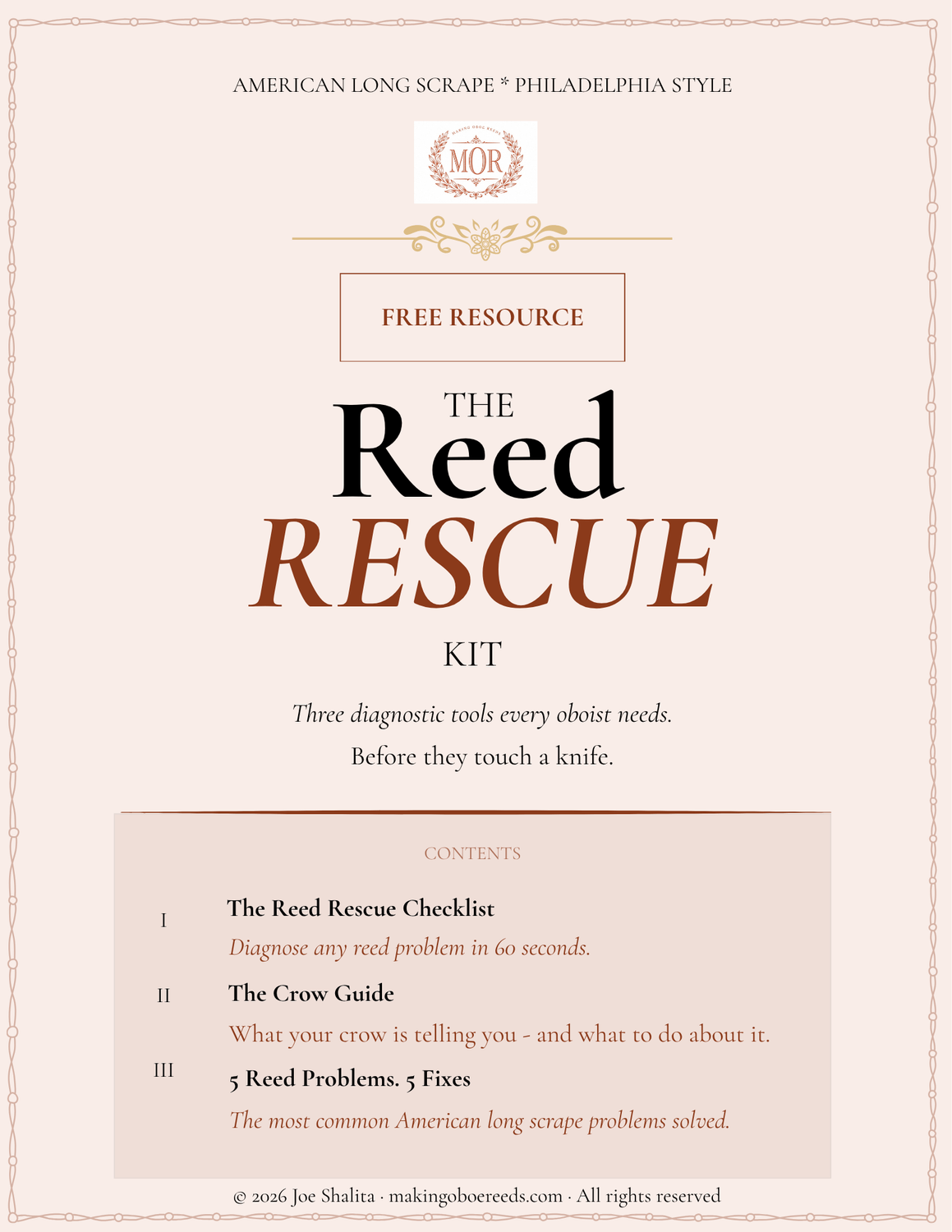
Download the free Reed Rescue Kit — includes my 5-problem diagnostic checklist and the crow guide that tells you exactly what your reed is trying to tell you.
makingoboereeds.com/reed-rescue-kit
Or go straight to the course: Making Oboe Reeds Online — $47 — 56 videos — everything I know.